Commercial Roofing Questions in Terre Haute
Straight Answers on Systems, Cost, Weather, and Permits
These commercial roofing questions in Terre Haute come from owners of plants, warehouses, offices, shops, and farm buildings.
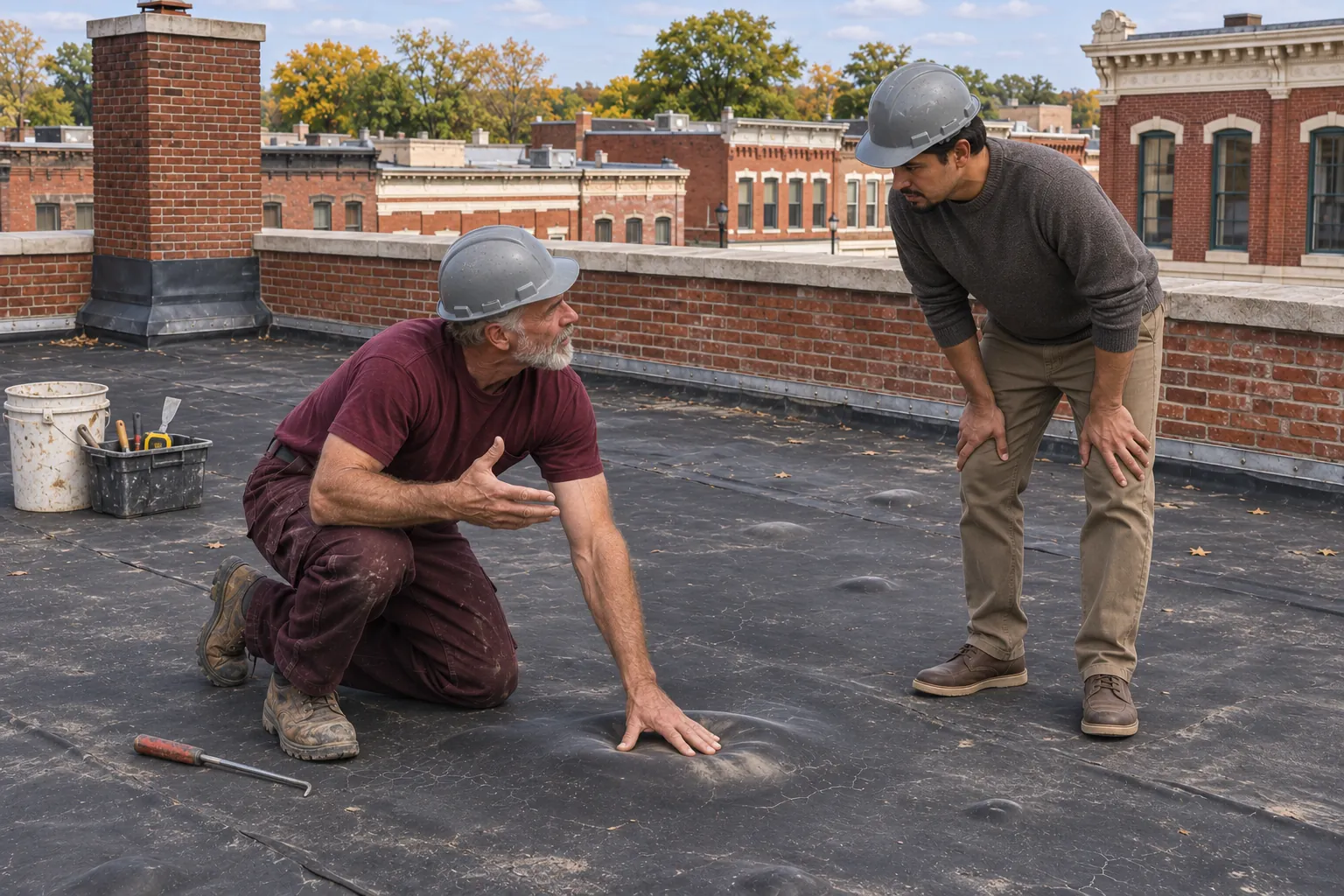
Answers to commercial roofing questions in Terre Haute are grouped by roof system, then weather, codes, and the towns we serve.
FAQ for Terre Haute Commercial Roofing, serving commercial and industrial buildings in Terre Haute, Brazil, Linton, Clinton, Pittsboro, and Sullivan, Indiana.
Commercial Roofing Questions in Terre Haute by System
Commercial Roofing in Terre Haute
- What should Terre Haute building owners look for in commercial roofing companies near me?
Look for a roofer that works on low-slope membranes and metal systems, inspects the roof before quoting, and explains the deck, insulation, and drainage plan in writing.
Ask how they will keep your building operating during the work and how they handle permits with the city. Compare scopes line by line as well as the totals.
- TPO vs EPDM: which fits a Terre Haute commercial building?
TPO is a white, heat-welded membrane that reflects sunlight and suits buildings with cooling loads and lots of rooftop traffic. EPDM is a black rubber membrane with taped or adhered seams that stays flexible in cold weather and is simple to repair. Roof size, penetrations, budget, and the existing roof decide which fits.
- How long does a commercial roof last on a Terre Haute building?
It depends on the system, installation quality, drainage, and maintenance. Single-ply membranes such as TPO and EPDM often last 20 to 30 years, and metal roofs often last longer. Ponding water, foot traffic, and neglected flashings shorten that. Twice-yearly inspections and prompt repairs help a roof reach the long end of its range.
- What drives commercial roof replacement cost in Terre Haute?
Roof size, the number of existing layers to tear off, deck repairs, insulation thickness, the membrane or panel chosen, and the number of curbs, drains, and penetrations all drive the price. Access, crane needs, and working around operations matter too. A free on-site estimate measures these and sets the price for your building.
- Do you replace whole commercial roofs in Terre Haute?
Yes. Commercial roof replacement covers tear-off, deck repair, new insulation, and a new TPO, EPDM, or metal roof system with new flashings and edge metal. We stage replacement in sections so tenants and production can keep working, and we close each section watertight before the end of the day.
TPO Roofing
- What is TPO roofing on a Terre Haute warehouse?
TPO (thermoplastic polyolefin) is a single-ply roofing membrane, usually white, installed over insulation on low-slope roofs. Its seams are fused with hot air into a continuous sheet. On a Terre Haute warehouse it is mechanically fastened or fully adhered, and it reflects summer sun to help keep the space below cooler.
- What are the downsides of TPO roofing for a Terre Haute building?
TPO quality varies by manufacturer and thickness, and thinner sheets wear sooner. The white surface shows dirt and can be slippery when wet or frosty. Seams depend on correct welding temperature and speed, so crew skill matters. It is also less forgiving of sharp debris and dropped tools than thicker membranes.
- How does TPO compare with EPDM on a Terre Haute distribution warehouse?
On a large warehouse, TPO's welded seams and white surface suit long runs and high summer heat. EPDM's rubber holds up well in freezing weather and is easy to patch. TPO handles forklift-style rooftop traffic paths better with walkway pads; EPDM often costs less to repair. We compare both against your drainage and penetrations.
- How does TPO seam welding work on a Terre Haute roof?
A robotic or hand-held hot-air welder melts the overlapping edges of two TPO sheets so they fuse into one piece.
We test-weld each morning to set temperature and speed for the day's weather, then probe every seam with a tool to find gaps. Welded seams do not rely on adhesive, which helps them hold through freeze-thaw.
EPDM Roofing
- What is EPDM roofing on a Terre Haute commercial building?
EPDM is a synthetic rubber roofing membrane, usually black, used on low-slope commercial roofs. It comes in large sheets with few seams, which are joined with tape or adhesive. It stays flexible in cold weather, which suits west-central Indiana winters, and it is often used on offices, schools, and older flat-roof buildings.
- What are common problems with EPDM roofs on Terre Haute buildings?
The most common issues are seam tape or adhesive letting go, shrinkage pulling at corners and flashings, and punctures from foot traffic or debris. Flashings around curbs and drains often fail before the field sheet does. Most of these problems can be repaired if they are found before water saturates the insulation.
- Fully adhered vs ballasted EPDM: which suits a Terre Haute roof?
Fully adhered EPDM is glued to the insulation, giving a smooth surface that is easy to inspect and repair. Ballasted EPDM is held down by stone, which is faster to install but adds weight and hides leaks. The roof structure's load capacity and wind exposure usually decide which one fits your building.
- When does an EPDM roof on a Terre Haute building need replacement?
When seams are failing in many places, the membrane is shrinking away from walls, or cores show wet insulation across large areas, replacement usually makes more sense than repair. We tear off the old system, repair the deck, add insulation, and install new EPDM or another membrane with new flashings.
Industrial Roofing
- What is industrial roofing for a Terre Haute food processing plant?
Industrial roofing covers the large, low-slope roofs of plants, warehouses, and processing facilities, where heavy rooftop equipment, exhaust, and process heat put more stress on the roof. On a food processing plant it also means planning around clean areas, fresh-air intakes, and grease or steam exhaust that can attack some membranes.
- How do you roof around rooftop equipment on a Terre Haute printing plant?
We flash each curb, duct, and support with membrane or metal flashings tied into the field sheet, and we raise curbs when the new insulation makes them too short. Walkway pads protect the path to units that need service. We coordinate shutdowns of exhaust and makeup air units so presses stay running where possible.
- What does industrial roof replacement involve in Terre Haute?
We survey the roof, core-test insulation, and plan the work in sections around production. Each day's section is torn off, the deck is repaired, insulation and the new membrane or metal system go on, and the area is sealed before crews leave. Equipment curbs, drains, and edges get new flashings as each section is finished.
- What should a Terre Haute plant expect from industrial roofing contractors?
Expect a written safety plan for working at height near running equipment, a work schedule built around your shifts, and a clear plan for protecting product and machinery below. Contractors should explain the system, deck repairs, and how they will handle rooftop units. Ask for daily updates while crews are on the roof.
Still Have a Question About Your Roof?
Leak Happening Now
Call and describe where the water shows up. We ask about the roof above it.
Call UsWeather, Permits, and Nearby Towns
Commercial Metal Roofing
- Standing seam vs exposed fastener: which metal roof suits a Terre Haute building?
Standing seam panels hide their fasteners in raised seams and use clips that let panels move with temperature, so they have fewer leak points. Exposed-fastener panels cost less and install faster, but every screw goes through the panel and needs checking over time. Standing seam suits long-term owners; exposed fastener suits budget-driven storage buildings.
- Is metal roofing a good fit for agricultural buildings near Terre Haute?
Yes. Metal panels suit barns, equipment storage, and grain-related buildings because they span purlins easily and shed snow. Ventilation and condensation control matter in livestock and storage buildings, so we plan vapor control and ventilation with the roof. Exposed-fastener panels are common here, with fastener checks part of routine upkeep.
- Can a metal roof go over an existing roof on a Terre Haute building?
Often, yes. A retrofit framing system can carry new metal panels over an existing low-slope or metal roof, avoiding a full tear-off. The structure must handle the added load, and existing wet insulation should be dealt with first. Code limits on the number of roof layers also apply, so we check them before planning.
- What affects commercial metal roofing cost per square foot in Terre Haute?
Panel type (standing seam or exposed fastener), metal gauge and finish, roof slope and size, tear-off or retrofit framing, insulation, trim, and the number of penetrations all drive the cost. Access and crane time matter on taller buildings. A free on-site estimate measures the roof and sets the price for your building.
- How do you install and maintain metal roofs on Terre Haute distribution warehouses?
We install panels over purlins or a retrofit frame with sealed laps, trim, and closures, then flash curbs and penetrations. Maintenance means checking fasteners, sealants, gutters, and panel laps each year, tightening or replacing loose screws, and clearing debris. Small rust spots are cleaned and touched up before they spread.
Weather, Codes, and Permits
- How does snowmelt cause leaks on Terre Haute flat roofs?
Snow melts during the day and refreezes at night, so ice forms at drains, scuppers, and gutters. Meltwater then backs up against flashings and seams that were never meant to hold standing water. Clear drains, correct slope toward them, and sound flashings are the best defense on Terre Haute low-slope roofs.
- What does Indiana summer heat do to commercial roof membranes in Terre Haute?
Summer heat and sun make roof surfaces expand, age membranes, and stress seams and flashings that are already contracting each winter. Dark membranes run hotter than white ones. Reflective TPO reduces heat gain on buildings with cooling loads, while EPDM's flexibility helps it move with temperature swings.
- Can spring hail damage a TPO or EPDM roof near Terre Haute?
Yes. Large hail can bruise insulation under the membrane, crack aged TPO, and puncture membranes over hard surfaces. Damage is not always visible from the ground. After a hailstorm we walk the roof, check seams and flashings, and take cores where bruising is suspected so repairs or claims are based on real findings.
- Who handles commercial roofing permits in Terre Haute?
The City of Terre Haute's Building Inspection Division confirms that required permits are purchased and checks work against codes adopted by the State of Indiana. We confirm permit requirements for each project with the city before work starts. Buildings outside city limits follow their own county or town building office.
- What Indiana code applies to a commercial reroof near Terre Haute?
Commercial roofs in Indiana follow the Indiana Building Code in 675 IAC 13, adopted by the Fire Prevention and Building Safety Commission.
The state also requires plan review for Class 1 structures, which covers most commercial buildings. Whether a reroof needs a state filing depends on scope, so we confirm with the state and local office.
Service Areas Around Terre Haute
- Do you install commercial roofs in Brazil, Indiana?
Yes. We install and replace TPO, EPDM, and metal roofs on commercial buildings in Brazil and nearby Clay County communities. Each project starts with a roof survey and core check. If your building is just outside Brazil, call or send us a message and we will tell you whether we can reach it.
- Do you handle commercial roofing in Linton, Indiana?
Yes. We work on flat and metal roofs on Linton shops, offices, and storage buildings. We look at drainage, the existing layers, and the deck before recommending TPO, EPDM, or metal. Owners in nearby Greene County towns can call to ask if their building falls within our area.
- Do you roof industrial buildings in Clinton, Indiana?
Yes. We install and replace roofs on industrial and commercial buildings in Clinton, including metal buildings and low-slope plants. Work is scheduled in sections around shifts, and rooftop equipment is flashed into the new system. Call to talk through your building's roof and timeline.
- Do you install TPO or metal roofs on Pittsboro warehouses?
Yes. We install TPO, EPDM, and metal roofs on warehouses and commercial buildings in Pittsboro. Large warehouse roofs are replaced in daily sections so loading docks and operations keep running. We start with a roof survey to plan drainage, insulation, and the system that fits.
- Do you work on commercial roofs in Sullivan, Indiana?
Yes. We install, replace, and maintain commercial roofs in Sullivan, from small retail buildings to metal shops and municipal buildings. If your building is outside the towns we list, call or send a message and we will let you know if we can serve it.
Ask Your Own Commercial Roofing Questions in Terre Haute
Call with the question or send the address. The answer starts with a look at your roof.